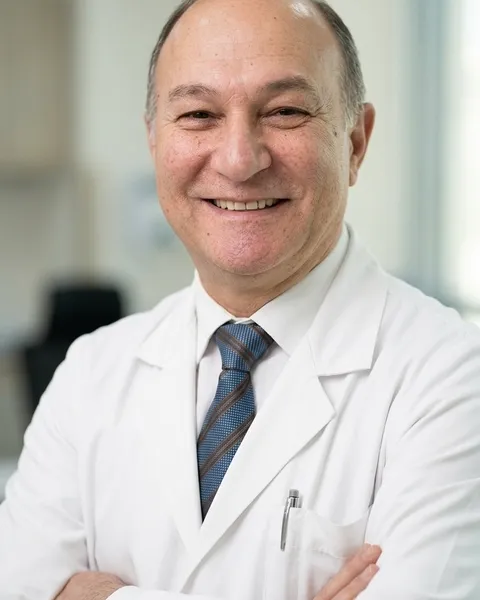
A career built across four countries
Dr. Naji Younes has spent three decades in general and laparoscopic surgery. He earned his Doctor of Medicine and completed his specialisation in General Surgery at the Lebanese University, then continued his training in Europe — first in Belgium at Ambroise Paré in Mons, and then across a series of French hospitals including Saint Joseph and Antoine Béclère in Paris, Beauvais, Delafontaine in Saint-Denis, and Sud Francilien in Évry, where he completed the French AFS and AFSA surgical qualifications.
He returned to Lebanon to practise at Rafic Hariri Government Hospital before moving to Saudi Arabia, where he spent eighteen years — first as Consultant Surgeon at the Royal Commission Health Center in Yanbu, then for twelve years as Head of Surgery at Hafar Al Batin Central Hospital, and most recently as Consultant in General and Laparoscopic Surgery at King Khaled General Hospital.
Laparoscopic surgery has been central to his practice for more than twenty-five years. He began operating laparoscopically during his hospital training in Belgium and France in the late 1990s, and has worked in minimally invasive technique continuously since — across gallbladder, hernia, colorectal and digestive surgery.
Alongside his hospital work he pursued advanced training in minimally invasive technique, including a Diploma in Laparoscopic Surgery and a Certificate in Laparoscopic Colorectal Surgery from IRCAD in Strasbourg — the institute widely regarded as the international reference centre for laparoscopic training — along with further coursework in colorectal, pancreatic and breast surgery.
He now practises in Beirut.
"A patient should leave the consultation understanding three things: what is actually wrong, what the options are, and why I am recommending one of them. If they don't, I haven't finished explaining."
How he works
Consultations are unhurried. Every patient receives a clear explanation of their diagnosis, the treatment options genuinely available to them, and an honest assessment of whether surgery is the right answer — including when it isn't. Second opinions are welcomed, and patients are never pressured toward an operation.
Dr. Younes consults in Arabic, French and English.